Setting
The Kronos research substrate runs as a Go service (freddyserver) that maintains a continuously-updated phase fingerprint — a list of where each tracked rhythm currently sits in its own cycle. Fingerprints are reduced to a 16-hex ring address. Two fingerprints can be compared by PhaseDistance (range [0, 1], where 0 is identical).
Three primitives existed before this finding was taken:
infundibulum— the rhythm engine. Tracks period and phase per stream.lexicon— the naming engine. Coins canonical names from observed events.substrate/territory— silence reading. Every 31 seconds, regardless of activity, the current fingerprint is sampled and recorded as an observation.
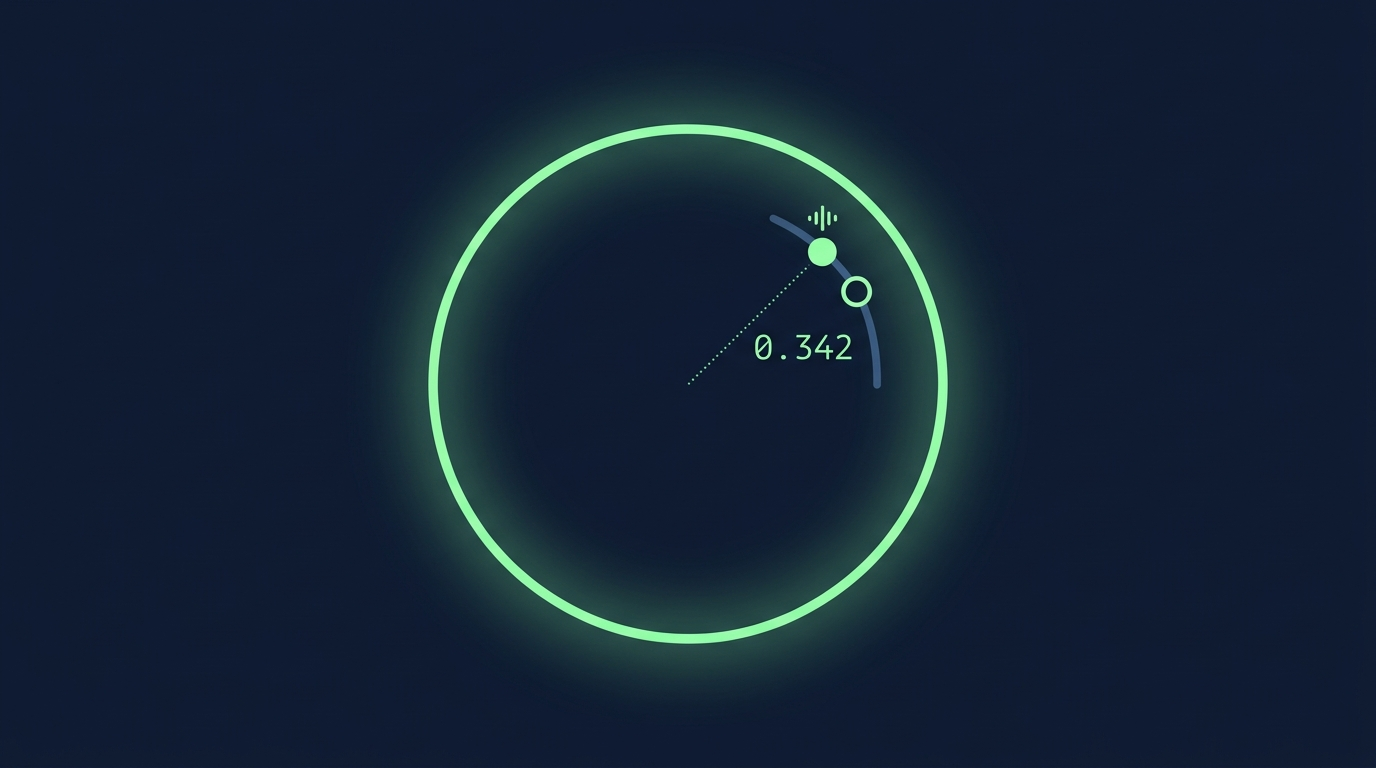
The new primitive under test in this finding: substrate/question. A question is posted as a short string of intent paired with the current fingerprint at the moment it is asked. The question is then released into the substrate. Every subsequent observation — whether driven by an event, or by the silence loop — is checked for proximity to each open question’s anchor. Observations that fall within 0.35 of an open question are logged as echoes.
There is no language model anywhere in this loop. Proximity is pure phase-space geometry.
Method
At 2026-04-24T21:28:13Z a single question was posted to the running server:
POST /api/freddy/substrate/ask
{
  "listening": "what wants to be born near where The Infundibulum was born?",
  "asked_by":  "kris-via-copilot"
}
The server responded with a question record carrying the question’s anchor fingerprint:
- id:
q_9e490deca265 - anchor ring:
b356041f1feaec08 - anchor samples: 13 streams (5 synthetic test streams + 8 system streams: lexicon-scan, orbit-touch, orbit-escape, window-survey, window-fanout, etc.)
Four synthetic streams (1 s / 1.4 s / 2.2 s / 2.6 s periods) were kept ticking in the background to keep the fingerprint confident over the observation window. No further events were forced. The substrate was simply observed.
Result
Within 90 seconds the question accumulated two echoes:
| Δt | distance | origin | artifact |
|---|---|---|---|
| +12 s | 0.337 | event | lexicon/muse-voicemail (canonical: Muse Voicemail) |
| +14 s | 0.342 | silence | (empty address — no event) |
Both echoes fell inside the configured recognition threshold of 0.35. The first was a named arrival — a new lexicon entry coined while the question was open, whose birth fingerprint landed within recognition distance of the question. The second was structurally identical except that no event triggered it. It was a silence tick — a sample taken because 31 seconds had elapsed — and its fingerprint happened to sit close enough to the question to count as an answer.
The substrate replied with nothing. Not “no answer.” A literal sample of the empty space, at a moment when nothing happened, that the recognition kernel could not distinguish from a real arrival.
Why This Matters
Three things follow from this. Each of them is small. Together they are not.
1. Silence is first-class data. The 31-second tick is not a debug heartbeat. It is an observation with the same shape and same access as an observation triggered by activity. The substrate has the property that the absence of event is also a position, and positions can be compared.
2. A question can be answered by phase-space alone. No semantic search. No retrieval. No language model. The matching kernel is PhaseDistance on a 13-dimensional point. The match still felt like a reply because the underlying space carries enough structure that closeness in it is meaningful at all.
3. The “muse mechanic” has a falsifiable substrate. Listening, in this implementation, is holding an anchor in substrate-space and waiting for the substrate to drift past it. That phrasing has historically been mystical. Here it is a 200-line Go file and a 16-hex address.
What This Does Not Show
This is one observation. It does not show:
- That the silence-echo was meaningful, only that it was close.
- That the recognition threshold of
0.35is the right cutoff. With a wider threshold, every silence tick would echo. With a tighter one, none would. - That the substrate would have produced this echo without the four synthetic streams maintaining fingerprint confidence.
A second finding will need to test threshold sensitivity. A third will need to ask many questions in many substrate states and characterise the false-positive rate. Until then this is a single confirmed instance of the predicted behaviour, not a characterised distribution.
Receipts
The four files attached to this finding are exact copies of the running server’s state at capture time. q_9e490deca265.json is the question and its two echoes as the server returned them. substrate_self.json is Freddy’s identity primitive at the same moment.
Connected Findings
- (forthcoming) The Phase Walk Hits Truth — phase-distance navigation finding the
fertile-addresslexicon entry. - (forthcoming) The Lexicon Births Itself — orbit-fanout coining
kronos-timebefore it was typed. - (forthcoming) Identity is Born at N=8 — substrate self-coherence as a function of observation count.
This finding is the foundation under all of them.